About Scholia
Scholia is a library of interactive lessons on the history and practice of computational art. Each lesson pairs the story of a pioneer (or a technique) with a working tool you can use right in the browser, at your own pace.
Why it's called Scholia
Scholia are the explanatory notes scholars wrote in the margins of ancient and medieval manuscripts. They were never the main text, but they often preserved knowledge that would otherwise have been lost. When the original sources vanished to war, censorship, or plain neglect, the marginal notes were sometimes all that survived.
For decades Vera Molnár, Georg Nees, Frieder Nake, Manfred Mohr, and the algorists worked in the margins of the art world. They were making art from rules long before the tools they imagined became the tools everyone uses.
Scholia is my set of notes in those margins. I'm an apprentice to their history, rebuilding their ideas as working tools until I understand them from the inside, and publishing my notes as I go.
Who made it
I'm Michael. I started designing on a computer in 1994, in art school at Bowling Green State University, and I've spent the thirty years since building for the web. Lately that work has been in AI, designing systems that compose with rules. So when the Toledo Museum of Art opened Infinite Images: The Art of Algorithms, I went expecting to see where all of this is heading. I got a history lesson instead.
I knew computational art existed. I didn't know how deep it went. I stopped at two works by Vera Molnár: a plotter drawing of nested squares, hundreds of them, hand-guided and machine-precise, and Themes and Variations, the on-chain series she made at 99 with Martin Grasser. It was her last work. She had been composing pictures from rules since the 1950s, a decade before she ever touched a computer. I had never heard her name. I needed to know more.
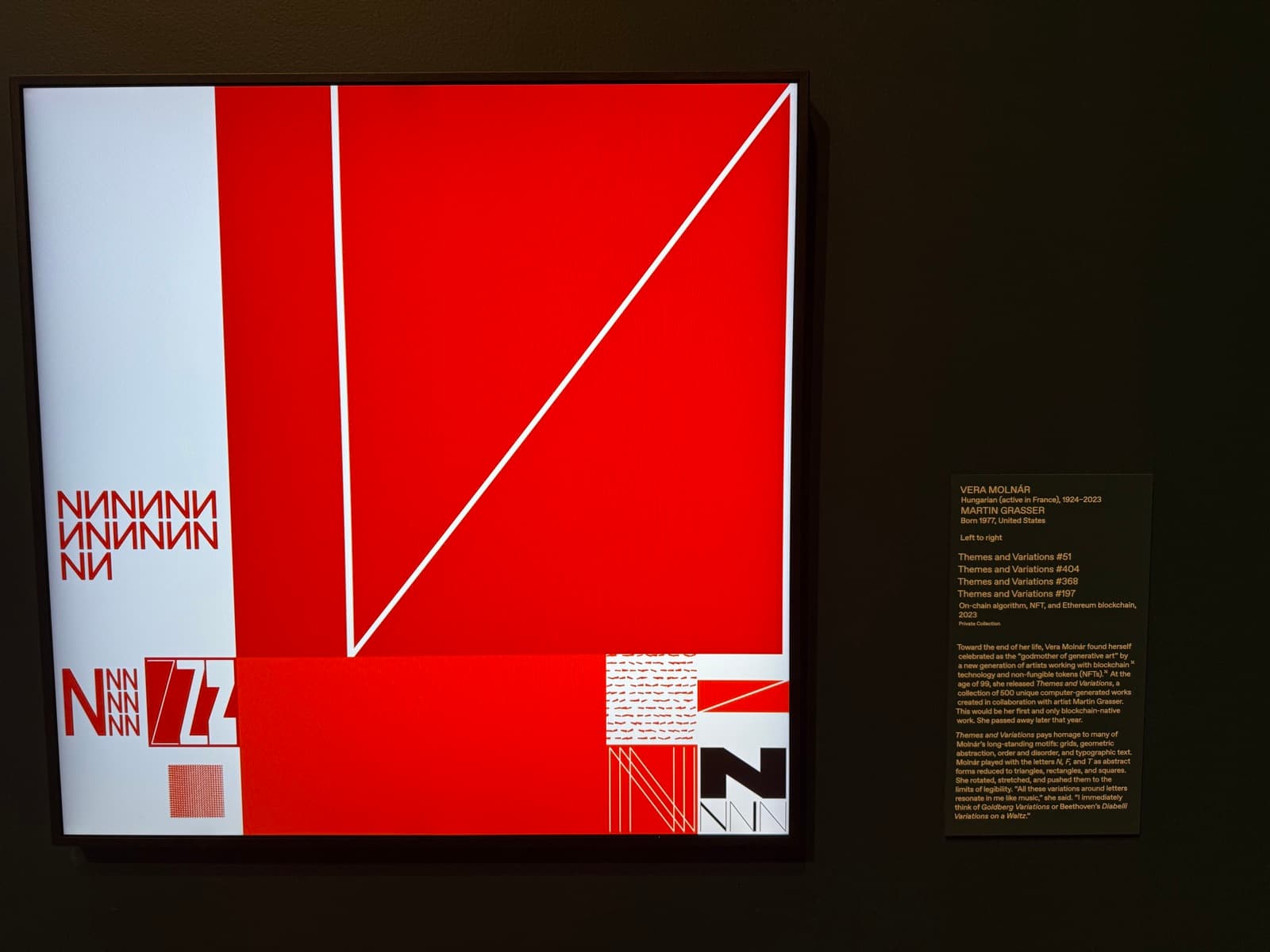
Scholia started in front of those two frames.
How the lessons are made
I'm using AI agents to teach me this history, and the lessons come out of that work. For each artist, agents gather sources into a research file, draft the lesson from it, check its claims against those sources, and help me build the studio tool. I read and edit every lesson before it goes up, and I keep asking questions until I understand what it says. The Scholiast in the margins is AI too, and it answers only from the library's own material.
So the lessons are written by AI and edited by a person. Mistakes can still get through. If you find one, tell me: hello@michaeljpaulus.com.
Sources & gratitude
A project built on other people's ideas had better credit them. Every lesson ends with its bibliography. The full list, along with how the library is researched and how the Scholiast is grounded, lives on the sources page.
How to use it
Start with any lesson and save the studies you make as you go. New lessons go up as I finish them.