Exhaustive Variation
Manfred Mohr (b. 1938)
From 1973 Mohr built his work on the cube's twelve edges, and later on higher-dimensional hypercubes.
From jazz and painting to programs
Manfred Mohr (b. 1938) was born in Pforzheim and trained as a gold and silversmith. He played tenor saxophone and oboe as a working jazz musician and painted gesturally into the 1960s. In Paris in the early 1960s he read Max Bense's information aesthetics and turned to rational, rule-based art. He later said in an interview:
"It was only when I got into the philosophy of Max Bense in the early 1960s that I understood that 'rational' thinking in art, as Bense proposed, could solve that problem." — Manfred Mohr, interview, Right Click Save
The composer Pierre Barbaud showed him how to think in algorithmic procedures. Mohr wrote his first programs, in FORTRAN IV, in 1967, and his first computer drawings date to 1969. From 1970 he drew on a Benson flatbed plotter (sources differ on the exact model, 1284 or 1286) at the Météorologie Nationale computer center in Paris.
1971: a solo show at the Musée d'Art Moderne
In 1968 Mohr co-founded the Art et Informatique seminar at the University of Vincennes and showed at Cybernetic Serendipity in London alongside Georg Nees and Frieder Nake. Then, from 11 May to 6 June 1971, the ARC gallery at the Musée d'Art Moderne de la Ville de Paris mounted Une Esthétique Programmée: twenty-eight framed drawings, a Benson plotter running live in the museum, and a panel for visitor comments. Mohr and the Digital Art Museum both describe it as the first solo museum exhibition of works entirely calculated and drawn by a digital computer.
The cube as an alphabet
In 1973 Mohr adopted the cube, generating signs from its twelve edges with combinatorial, logical, and additive operators. The idea grew out of an earlier work, Sphereless (P-128, 1972), which used a square's four sides plus its two diagonals. He later described the choice:
"I came to the idea of the cube and decided that it could be my instrument. Out of this, I developed a whole graphical alphabet which replaced the linearity of my earlier algorithms." — Manfred Mohr, interview, Right Click Save
Mohr developed the Cubic Limit algorithm from 1973 to 1977 (Cubic Limit I, 1973 to 1976; Cubic Limit II, 1976 to 1977). Each of the twelve edges is either drawn or not, which gives two to the twelfth, or 4096, possible edge subsets. Mohr did not draw all of them; he applied his operators to the alphabet and chose among the results. The tool on this page draws a grid of cubes, each cell a different selection from the same twelve edges.
Hypercubes and color
From 1978 Mohr moved to the four-dimensional hypercube, the tesseract. Dimensions I (1978 to 1980) introduced his "diagonal path" device. space.color (around 1999 to 2003) brought his first color after roughly three decades of black and white. It is built on the six-dimensional hypercube, with 720 possible diagonal paths, four selected algorithmically, drawn as thick lines threaded by thin connecting vectors. Mohr used the color to clarify spatial ambiguity rather than to decorate. klangfarben (2006 to 2007) took its name from Klangfarbenmelodie and drew the diagonal paths of an eleven-dimensional hypercube, high-chroma color on black, with a logic borrowed from the rules of serial music.
Mohr on his aims
In his own words:
"My artistic goal is reached when a finished work can visually dissociate itself from its logical content and convincingly stand as an independent abstract entity." — Manfred Mohr (Digital Art Museum; ACM SIGGRAPH History Archives)
His honors include a 1990 Golden Nica at Prix Ars Electronica and the 2013 ACM SIGGRAPH Distinguished Artist Award for Lifetime Achievement in Digital Art.
The Sol LeWitt lesson and the Vera Molnár lesson cover related work. LeWitt handed a single instruction to many drafters, and Molnár worked a matrix of forms from order into disorder. Mohr spent decades on the variations of one shape and its higher-dimensional relatives.
In the tool, pick a Preset based on one phase of Mohr's work, then set Grid size, the Min and Max number of edges drawn, and the Rotation range. Every cell is computed from the seed, so the same settings and seed always return the identical grid, and a saved plate is the seed and settings that reproduce it.
The Studio
Adjust the controls and save the studies you want to keep.
Exercises
1. Hold one variable still
~6mLoad Cubic Limit and set Rotation range to 0, so every cell shares one orientation. Now the only difference between cells is which edges are drawn. Read the grid as a catalogue of edge subsets, then raise Rotation range to add a second variable.
Goal: See that a single varying parameter (the edge subset) already fills a whole grid with distinct signs.
2. Build a parameter space with consistent variety
~10mAdjust Min, Max, and Rotation range until every cell looks like part of the same family but no two are alike. Set too narrow, the grid looks repetitive; set too wide, it looks random. Find settings where the rule stays clear and the cells still vary.
Goal: Learn to size a parameter space so a constraint produces family resemblance without repetition.
3. Reproduce a Cubic Limit study
~10mStarting from the Cubic Limit preset (black lines on white), adjust Grid size, Min, and Max until the grid could pass for a page from Mohr's own portfolio. Save it under Save This Plate, then load it from your library and confirm the same grid comes back.
Goal: Make a plate in the manner of Cubic Limit and confirm the saved seed reproduces it exactly.
4. Generate many, curate five
~12mKeep your settings fixed and press New seed a dozen times, saving each grid you find interesting. Then do what Mohr did with the output of his operators: discard most and keep the five strongest. Write one line on why you kept each.
Goal: Practice choosing among generated results, the part of the work the machine leaves to you.
5. Rebuild a grid from its seed
~7mWrite down a seed number and the settings that go with it. Load a different preset and press New seed, then rebuild the grid from your notes alone. A saved Mohr plate is a seed and its settings, and those are enough to reproduce it exactly.
Goal: Confirm that a seed and its settings are enough to rebuild a generative work.
Sources & further reading
Primary sources
Manfred Mohr, documentation of the 1971 exhibition at the Musee d'Art Moderne de la Ville de Paris (ARC).
Dates, the 28 drawings on view, the live plotter, and the visitor comment panel.
Manfred Mohr, "Combinatoric," artist's theme page.
The Cubic Limit series and the hypercube diagonal-path device.
"An Interview with Manfred Mohr." Right Click Save.
Mohr's own words on Bense, and on the cube as his instrument and graphical alphabet.
The works
Manfred Mohr, P-128 Sphereless (1972), artist's own documentation.
The square's four sides and two diagonals as alphabet, and the 1973 cube as its expansion.
bitforms gallery, artwork record for P-128-B Sphereless (1972).
Quotes Mohr on the earlier Sphereless program, corroborating the artist's own site.
Museum and foundation records
Musee d'Art Moderne de la Ville de Paris, exhibition archive for "Manfred Mohr: une esthetique programmee," ARC, 11 May to 6 June 1971.
Authoritative museum dates and venue for the 1971 show.
Digital Art Museum (Berlin), artist page for Manfred Mohr.
The cube from 1973, Cubic Limit dates, the space.color and klangfarben series, and the Golden Nica.
Digital Art Museum, record for Dimensions I (1978 to 1980).
The move to the four-dimensional hypercube and the diagonal-path device.
Computer History Museum, record for Sphereless.
Corroborates the Sphereless work and its dating.
Further reading
ACM SIGGRAPH History Archives, 2013 Distinguished Artist Award citation for Manfred Mohr.
The 2013 award and its citation of his algorithmic-geometry achievement.
"Manfred Mohr," Wikipedia.
Birth date and place, early career, first computer drawings, and awards (corroboration only).
"The Machines That Drew the Future." RCM Paris (Substack).
The 1967 first FORTRAN IV programs and the 1970 plotter access at Meteorologie Nationale.
Related lessons
Order and Disorder
Vera Molnár (1924-2023)
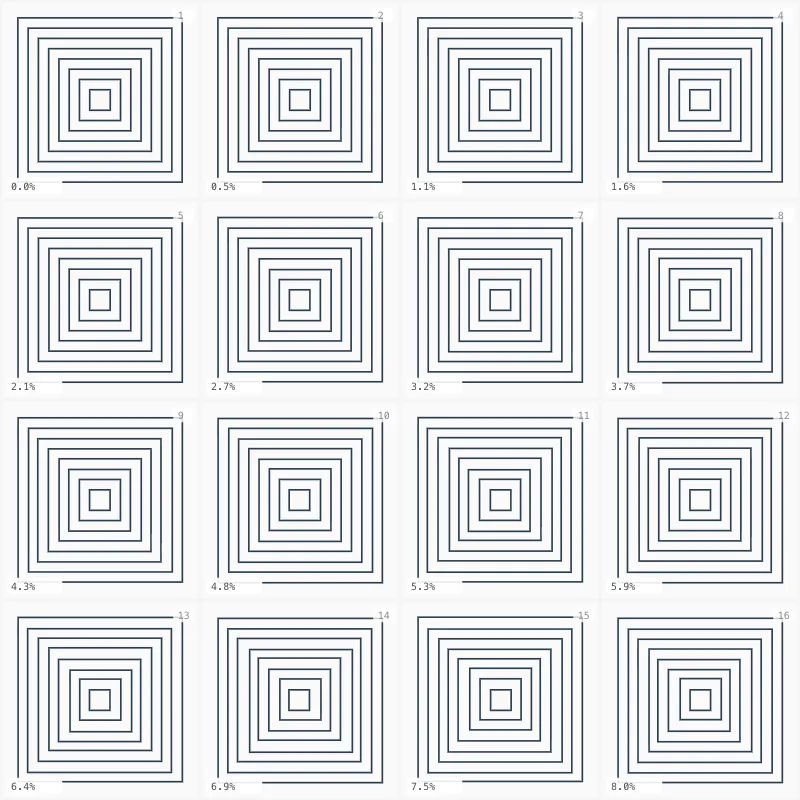
She added a small, controlled amount of randomness, her 1% disorder, to strict geometric order.
Instructions as Art
Sol LeWitt (1928-2007)
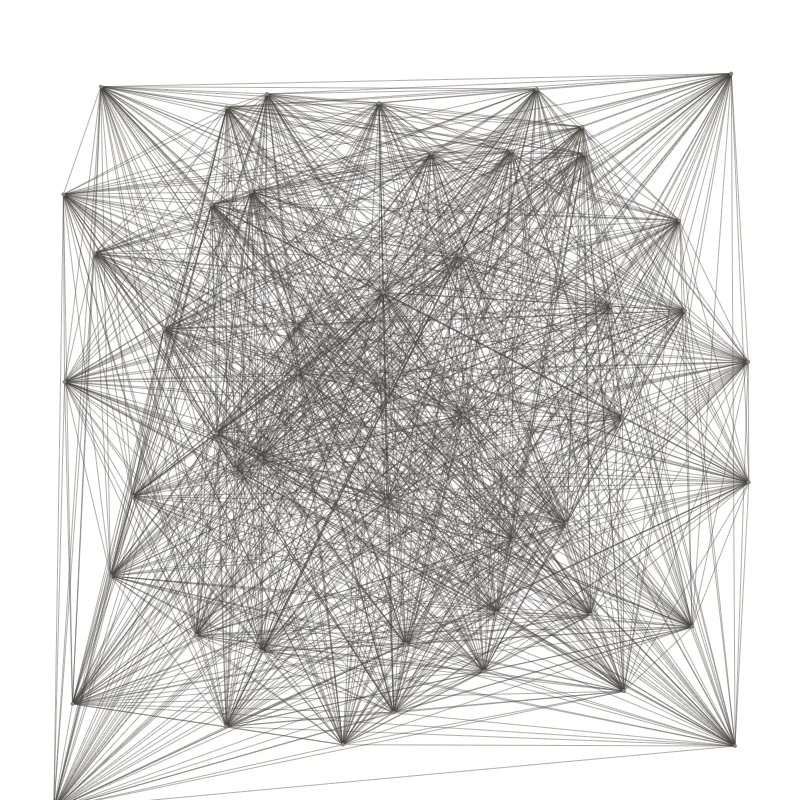
LeWitt's wall drawings are written instructions, drawn by other hands and redrawn wherever they are shown.