Order and Disorder
Vera Molnár (1924-2023)
She added a small, controlled amount of randomness, her 1% disorder, to strict geometric order.
The imaginary machine
Vera Molnár (1924–2023) was making algorithmic art a decade before she touched a computer. In the late 1950s she began working with what she called her machine imaginaire, an imaginary machine. She wrote out rules by hand and executed them herself, step by step, like a human processor: draw this shape, shift it by a roll of the dice, repeat. The randomness was real, pulled from dice or the phone book, but it stayed inside the rules she had set.
She meant the method as a rebuke to the myth of the artist-genius. Picasso had boasted, "I do not seek, I find." Molnár's lifelong motto reversed it: "Je ne trouve peut-être pas, mais je cherche" ("I may not find, but I seek"). For her, art was a systematic search through a space of possibilities.
1% disorder
Molnár got computer access in 1968, at the experimental psychology laboratory of the Sorbonne, and wrote Fortran and later BASIC. She used the computer to make her forms deliberately imperfect. Her usual method was to take a strictly ordered structure, a grid or a stack of concentric squares, and add a small, controlled amount of randomness. She called it "1% disorder", the small deviation that keeps a geometric system from looking mechanical.
Molnár kept the disorder small enough that the underlying grid stays readable. Interruptions (1968–69), one of her first computer series, took grids of short lines and randomly rotated and erased parts of them. (Des)Ordres (1974) applied the same idea to nested squares, the form Josef Albers painted, with each square knocked slightly off true.
"There is nothing more human than a computer because it was invented by men." — Vera Molnár
Grids of variations
Molnár's notebooks are full of grids of variations: the same algorithm run again and again, stepped from order toward disorder so the progression is visible. This tool lays out sixteen panels from one algorithm, with disorder rising from the first panel to the last.
A seed, a single integer, fully determines the "random" choices, so you can reproduce any matrix exactly by entering its number again. The disorder comes in four independent dimensions (position, rotation, scale, omission) that you can turn on together to find compound effects.
Molnár worked this way for the rest of her life. The Venice Biennale showed her work in 2022, when she was 98, and in July 2023 a Sotheby's auction of her last generative series, Themes and Variations, passed a million dollars, a few months before she died at 99.
The Studio
Adjust the controls and save the studies you want to keep.
Exercises
1. Find where order breaks
~8mWith only Position disorder on, slowly raise End. Look across the panels from 1 to 16 and find the first one where the order reads as broken.
Goal: Identify the disorder % where the eye stops seeing a grid.
2. The 1% principle
~8mSet Start and End both very low, under about 2%. This is the range of Molnár's 1% disorder. Decide whether the imperfection reads as a mistake or as something alive.
Goal: Make a matrix where the disorder is felt but hard to point to.
3. Compound disorder
~10mTurn on two or three disorder dimensions at once, for example Position, Rotation, and Omission. Look for an effect that no single dimension produces when you raise it alone.
Goal: Discover a compound effect you couldn't get from one dimension alone.
4. Recover a matrix from its seed
~5mNote the Master Seed number, click New Seed a few times, then type the old number back in. The same matrix returns, because every variation can be rebuilt from its seed.
Goal: Recover a specific matrix by re-entering its seed.
5. Compare ramp curves
~8mKeep Start and End fixed and switch the Curve between Linear, Exponential, and Logarithmic. The first and last panels stay the same, but the panels in between move toward disorder at a different pace.
Goal: Save three matrices that differ only by ramp curve.
Sources & further reading
Primary sources
"An Interview with Vera Molnar." Right Click Save.
Her motto set against Picasso's, the machine imaginaire around 1960, and GRAV's founding and her departure, in her own words.
Museum and foundation records
Digital Art Museum, artist page for Vera Molnar.
Machine imaginaire dates, the 1968 Sorbonne computer access, and the 1% disorder concept.
DAM Projects, "1965: The Beginning."
Georg Nees's 5 February 1965 exhibition, the first showing of algorithmic computer art.
Scholarly sources
compArt (University of Bremen), exhibition record for Nake and Nees, "Computer-Grafik."
Corroborates the 1965 dating of the Nake and Nees exhibitions.
Further reading
"Vera Molnar," Wikipedia.
Birth and death dates, marriage to François Molnár, and GRAV founding.
"Vera Molnar: The Grande Dame of Generative Art." Sotheby's.
The 1968 Paris computer center access and the 2023 Themes and Variations series.
"Vera Molnar NFT Auction at Sotheby's Realizes $1.2 Million Total." ARTnews.
The Themes and Variations sale total, a few months before her death.
"Molnar's Themes and Variations Fetches 631 ETH at Sotheby's." NFT News Today, 28 July 2023.
Second confirmation of the sale price and format.
"Vera Molnar at the Venice Biennale," Artnet News.
Her inclusion in the 2022 Venice Biennale at age 98.
Related lessons
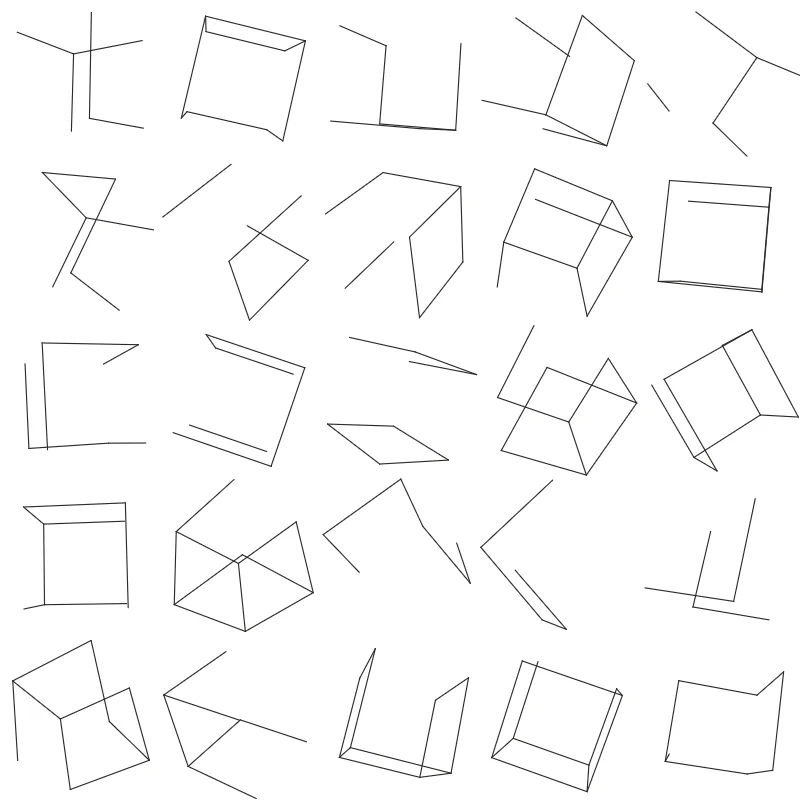
Exhaustive Variation
Manfred Mohr (b. 1938)
From 1973 Mohr built his work on the cube's twelve edges, and later on higher-dimensional hypercubes.
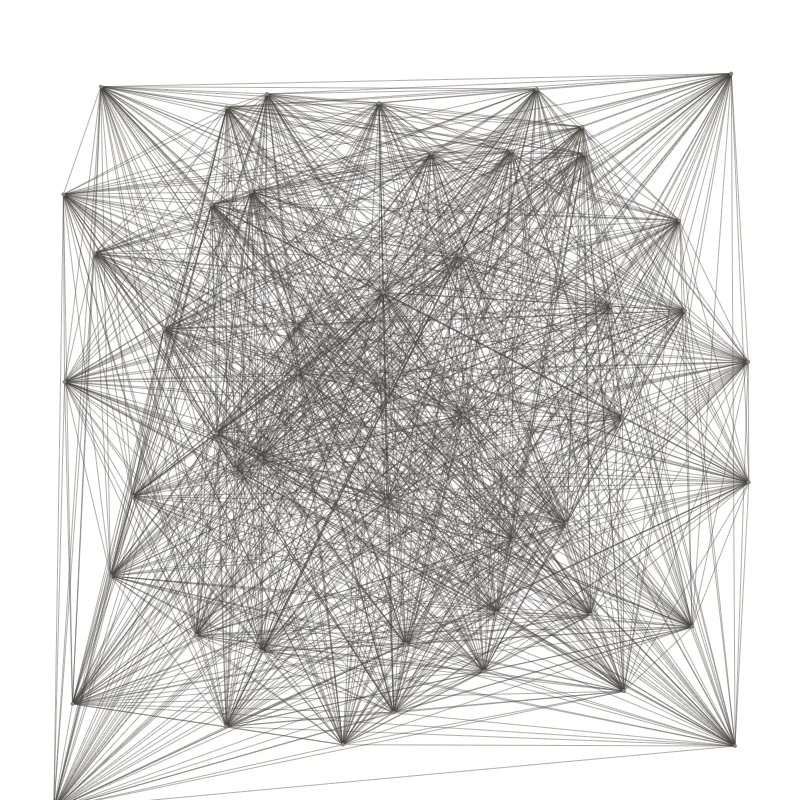
Instructions as Art
Sol LeWitt (1928-2007)
LeWitt's wall drawings are written instructions, drawn by other hands and redrawn wherever they are shown.
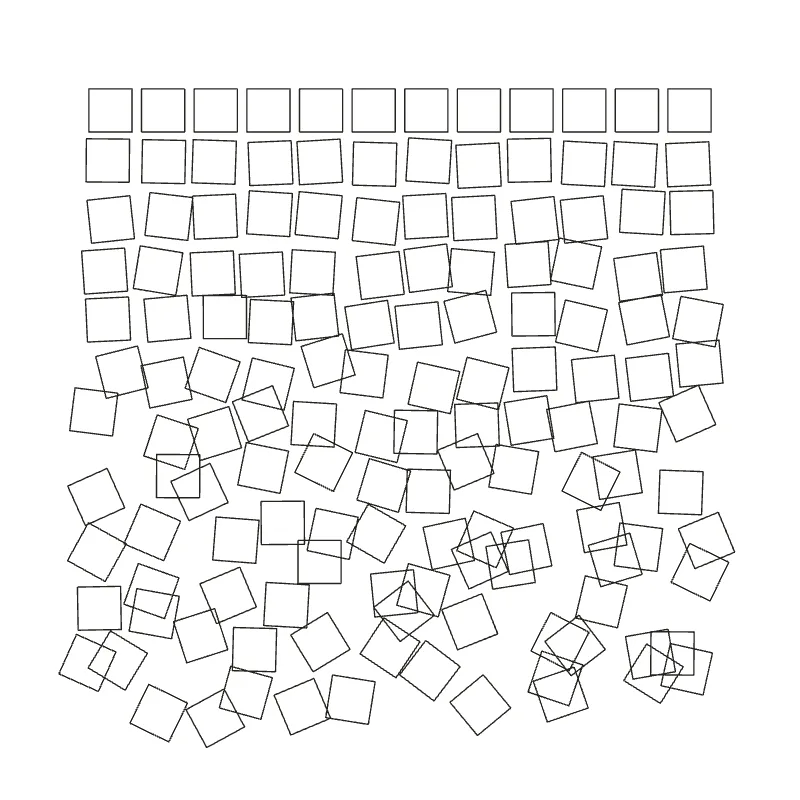
The First Computer Artists
Georg Nees & Frieder Nake
Two mathematicians who hung plotter drawings in Stuttgart galleries in 1965 and called them art.