Instructions as Art
Sol LeWitt (1928-2007)
LeWitt's wall drawings are written instructions, drawn by other hands and redrawn wherever they are shown.
What a LeWitt wall drawing is
When a collector buys one of Sol LeWitt's (1928–2007) wall drawings, no object changes hands. The sale transfers a certificate of authenticity, a diagram, and a set of written instructions. Drafters follow the instructions to draw directly on a wall, and when the show comes down, the wall gets painted over. The same certificate can be used to draw it again somewhere else, on a different wall, by different hands.
Under this arrangement the instructions are the artwork, and each wall holds one execution of them, much as a program's source file stays the same however many times it is run. That is also why LeWitt's work continued after his death. The MASS MoCA retrospective opened in 2008, the year after he died, and was planned to run for twenty-five years, its walls repainted and redrawn from the same certificates.
The 1967 essay and the first wall drawing
LeWitt argued for this in print a year before he drew on a gallery wall. In Paragraphs on Conceptual Art (Artforum, June 1967) he wrote:
The idea becomes a machine that makes the art.
— Sol LeWitt, "Paragraphs on Conceptual Art," Artforum, June 1967
The machine in that sentence is the plan, and the finished picture is what it produces. The same essay describes what that leaves for the execution:
When an artist uses a conceptual form of art, it means that all of the planning and decisions are made beforehand and the execution is a perfunctory affair.
— Sol LeWitt, "Paragraphs on Conceptual Art," Artforum, June 1967
Writing a program and running it divides the work the same way.
LeWitt made his first wall drawing in October 1968, at the Paula Cooper Gallery in New York, for the gallery's inaugural benefit exhibition. Wall Drawing #1 now belongs to SFMOMA, which is to say the museum owns the certificate and redraws the work on its own wall whenever it is shown.
Why executions differ
Give the same page of words to two drafters and you get two different drawings, and LeWitt wrote his instructions to allow for that. He is often quoted as saying that each person draws a line differently and each person understands words differently; whether or not he put it that way, the wall drawings bear it out.
Wall Drawing #797 (1995) is built on that variation. A first drafter draws an irregular horizontal line near the top of the wall. The next copies that line as closely as they can without touching it, the next copies that copy, and so on to the bottom of the wall. Because each line copies the one above it rather than the first, small errors accumulate, and the lines drift further from the original the lower they sit on the wall.
Music is a closer comparison than painting. A LeWitt instruction works like a score, and each execution like a performance that follows the notes but differs in its details, the way two pianists play the same sheet music differently.
LeWitt's palette
LeWitt worked in a narrow set of colors: black, gray, red, yellow, and blue, on white walls. In the ink-wash work of the 1980s he built up depth by layering transparent washes of those same colors. The tool's color list sticks to the same set.
Writing instructions in the tool
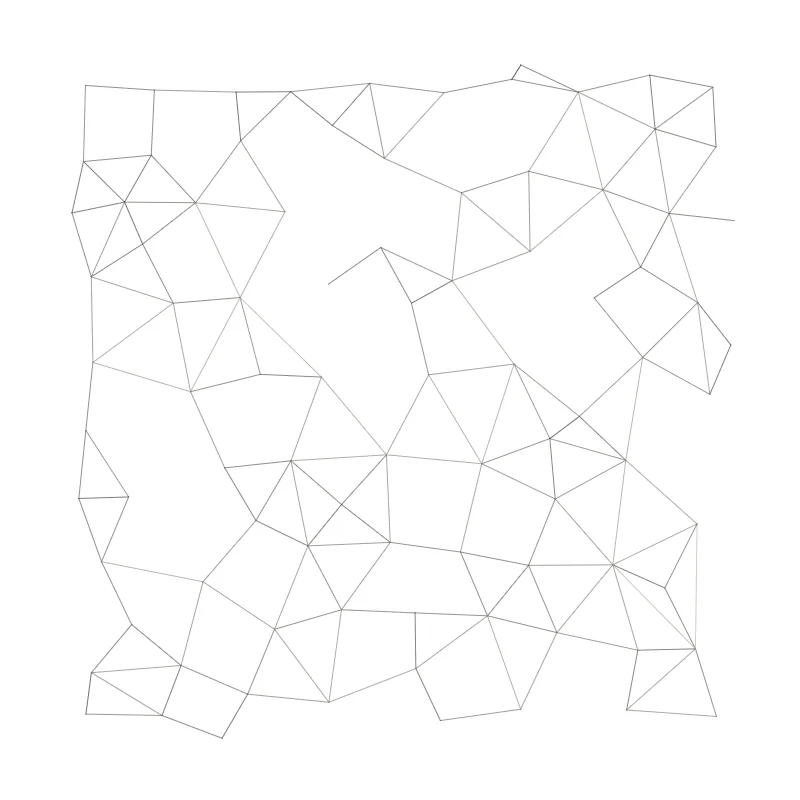
The tool has a wall and an editor for plain-language instructions. You write the instructions, and the program draws them, taking the place of LeWitt's drafters. The presets load real wall drawings, lightly adapted to the tool's grammar; Wall Drawing #273 in particular is simplified from a seven-wall piece to a single wall of edge-to-edge lines. Run one unchanged, then change a single number and press Execute again. Then clear the editor and write three lines of your own.
If the parser can't read a line, it skips it, lists it under Draftsperson notes, and draws the rest, much as a human drafter would interpret an unclear instruction instead of refusing to draw.
LeWitt rejected the view, common among his critics, that this was a cold, mechanical practice. Sentences on Conceptual Art (1969) begins:
Conceptual artists are mystics rather than rationalists. They leap to conclusions that logic cannot reach.
— Sol LeWitt, "Sentences on Conceptual Art," 1969
LeWitt and Vera Molnár
Vera Molnár began her machine imaginaire method in 1959. She wrote out a set of rules and carried them out herself, by hand, as if she were the computer. That was nine years before LeWitt's first wall drawing. She got access to an actual computer in 1968, the year LeWitt drew on his first wall.
Both were writing a plan and handing its execution to someone or something else. LeWitt handed his to a person with a marker, Molnár hers to a machine, and the art world of the time took his version far more seriously than hers and the other computer artists'. The Vera Molnár lesson covers the same years from her side.
The Studio
Adjust the controls and save the studies you want to keep.
Exercises
1. Execute a real wall drawing
~5mLoad the #118 preset. LeWitt's instruction says to place fifty points at random, evenly distributed, and connect all of them with straight lines. Press Execute, then read the instruction again beside the drawing it produced.
Goal: Run an original LeWitt instruction unchanged and read it the way you would read code.
2. Change exactly one variable
~6mWith #118 loaded, change only the number of points (the word fifty) and press Execute after each change. Try 8, then 30, then 120. Find the count where the connected lines stop reading as a shape and start reading as a field.
Goal: Change one variable and see how much of the drawing it controls.
3. Write your own three lines
~10mClear the Instructions box and write three lines of your own: two that place or draw marks, and one color line. Use the presets as examples of phrasing the parser understands. Draftsperson notes will flag any line it skips.
Goal: Write an original instruction set that executes with no skipped lines.
4. Surprise yourself
~10mWrite an instruction set whose output you can't predict before you press Execute. Combine bands, scattered lines, and color rules, then press New seed until you get a drawing you did not intend. Note whether you like it more than the one you planned.
Goal: Produce a result that surprises you, and decide what that says about authorship.
Sources & further reading
Primary sources
Sol LeWitt, "Paragraphs on Conceptual Art." Artforum, vol. 5, no. 10 (June 1967).
Confirms the exact wording of "the idea becomes a machine that makes the art."
Sol LeWitt, "Sentences on Conceptual Art" (1969).
Full reproduction confirming the wording of the opening sentences.
Museum and foundation records
San Francisco Museum of Modern Art, catalog record for Wall Drawing 1: Drawing Series II 18 (A & B).
Title, October 1968 date, and current home in the Fisher Collection.
Paula Cooper Gallery, "50 Years: An Anniversary," on the gallery's October 1968 inaugural benefit exhibition.
The venue and occasion for LeWitt's first executed wall drawing.
Mass MoCA, "Sol LeWitt: A Wall Drawing Retrospective."
Opened November 2008, on view through 2043, 105 wall drawings.
Mass MoCA, exhibition record for Wall Drawing #797.
Execution details for the instruction in which each drafter copies the line above.
Dia Art Foundation, collection record for Wall Drawing #118 (1971).
Full instruction text for fifty randomly placed points connected by straight lines.
Art Institute of Chicago, artwork record for Wall Drawing #118.
The short title form of the instruction.
The Museum of Modern Art, 1971 Sol LeWitt exhibition catalog.
Context for the 1971 wall drawings, including #118 and #86.
Scholarly sources
Bibliographic record for first publication of "Sentences on Conceptual Art": 0-9 (New York), 1969, and Art-Language (Coventry), vol. 1, no. 1, May 1969.
Establishes the two first publication venues.
Related lessons
Software as Medium
Casey Reas (b. 1972)
The co-creator of Processing argued that software itself is an artistic medium worth taking seriously.
Order and Disorder
Vera Molnár (1924-2023)
She added a small, controlled amount of randomness, her 1% disorder, to strict geometric order.
Exhaustive Variation
Manfred Mohr (b. 1938)
From 1973 Mohr built his work on the cube's twelve edges, and later on higher-dimensional hypercubes.